
The 5p launch kit
Approve an idea and, 25 seconds later, have the page story, giving levels, supporter email, social posts and a dated plan — for about 5p. The model writes the words; code owns every fact.

Subhankar Denria
CTO & product engineer
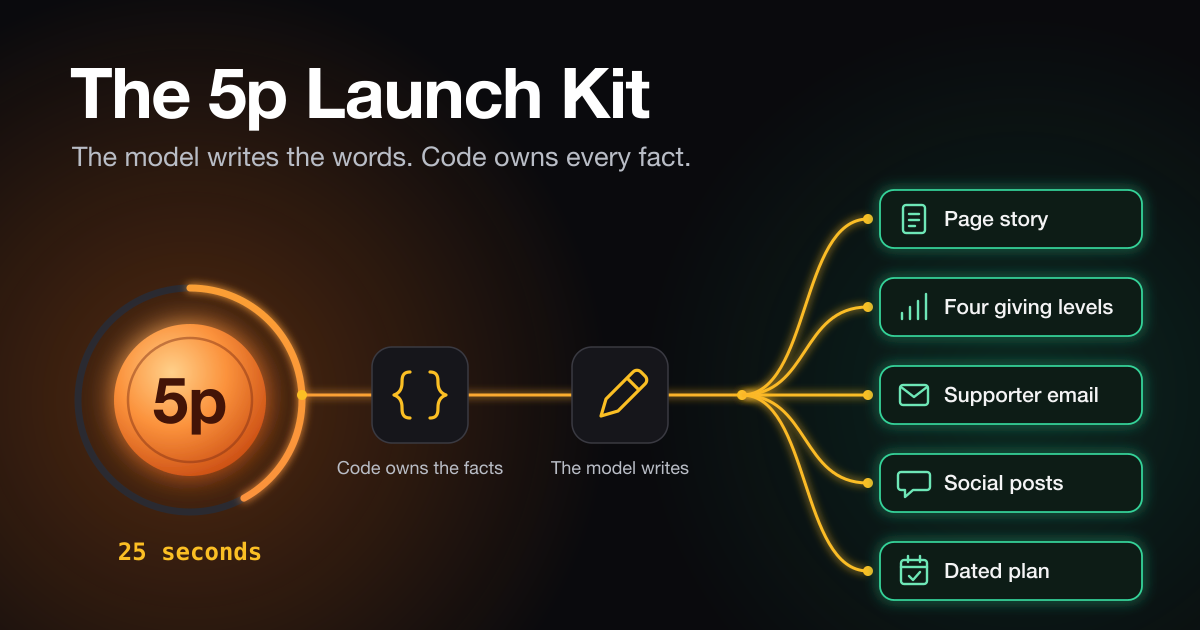
An organisation picks one of four researched ideas. About 25 seconds later it has everything it needs to launch: a page story, four giving levels, a supporter email, posts for four social channels, and a dated plan with a message for every step. Writing all of that costs about 5p.
The first post covered how a research run went from £2.05 to 13p. The Three-Minute Button covered the plumbing that makes that run dependable. This series is the last step: turning an approved idea into something a small team can put in front of its supporters this afternoon.
- What one approval produces
- A page story, four giving levels, a supporter email, four social posts and a dated plan
- What it costs
- About 5p, in about 25 seconds
- What makes it safe to publish
- The model writes the words. Code owns every fact
What lands on the review page
Approving an idea does two things at once. It creates the draft, and it queues a job that writes the kit around it.
The admin approves one idea
A draft is created, and the kit is written around it
A page story
Four sections, laid out and ready
Four giving levels
Each with a line on what it could do
A supporter email
Subject and body, ready to copy
Four social posts
One written for each channel
A dated plan
A message to send at every step
~25s · ~5p
One model call for all five
The admin lands on a review page with five tabs — Page, Supporter Email, Social Content, Plan and Research Sources — a copy button on every block, and eight readiness checks before publishing.
Sending and posting stay with the organisation. They copy the text and send it from their own accounts, in their own name. That keeps a person between the model and the public, which matters most where the whole relationship runs on trust.
Why it's worth building
An idea and a draft are the start of the job, and small organisations rarely have a marketing person to do the rest. The kit closes that gap. The page needs a story, supporters need an email, each channel needs a post, and someone has to decide what gets sent in week two. All of it is ready before the kettle has boiled.
What they are getting isn't "AI". It's a launch they can run today.
The one rule: facts by code, words by the model
Everything in this series follows from one division of labour.
Code owns the facts
- The title
- The target
- Start and end dates
- Every amount
- Every date in the plan
- The page layout
Right every time, and free to change later.
The model owns the words
- The page story
- What each level could do
- The supporter email
- The social posts
- The message for each step
Warm, clear sentences: the part it does best.
Before the model is called, plain code gathers the facts: the title, the target, the start and end dates. They go into the prompt under the heading use these facts exactly. The model's job is the part it's good at — warm, clear, well-shaped sentences. Dates, amounts and layout never leave code.
That division is what makes the kit both cheap and safe to publish. It's also why changing a giving level later costs nothing at all.
The whole journey, priced
From "we have no idea what to run" to "we have a draft and everything needed to promote it":
- A run, first timeLive web research, then four ideas£0.51 – £1.16
- A run in the next 30 daysResearch is reused, so only the ideas are paid for~13p
- The launch kitOne call, no web tools~5p
The whole journey
Research already on file
~18p
First time for an organisation
up to ~£1.20
Every figure there is measured, not estimated. Each model call records its own tokens and cost next to the thing it produced, at the rates for the model that actually ran.
The five ideas, in one line each
If you read nothing else:
- Give the model the facts and take back only words. Then check the words.
- Compute anything computable. Dates, sums and layout don't need a model, and code gets them right every time.
- Use placeholders for values that can change, and fill them in when the text is shown. Edits then cost nothing.
- Record the cost of every call next to the thing it produced.
- Put caps in the product, and the cost of serving a customer becomes arithmetic you can do before anyone signs up.
What's in each part
| # | Part | What it answers |
|---|---|---|
| 1 | Where 5p comes from | Why the kit is cheap, and how usage caps turn cost into a number you know in advance |
| 2 | Code owns the facts | Dates from rules, a schema built per request, and a page layout the model never touches |
| 3 | Edits that cost nothing | Placeholders filled at display time, checks on every figure, and a person behind every claim |
1
- What it answers
- Why the kit is cheap, and how usage caps turn cost into a number you know in advance
2
- What it answers
- Dates from rules, a schema built per request, and a page layout the model never touches
3
- What it answers
- Placeholders filled at display time, checks on every figure, and a person behind every claim
A note on what's shown here
The product isn't named, and nothing here identifies a customer. Names of tables, fields and screens have been made generic, and code is shown as pseudocode rather than in any one language. The costs are real: they come from live runs with early organisations.
Booking new builds now